

8. A TRIP IN THE HEART OF DANTE'S LANDS
Le città di Lamone e di Santerno
conduce il lionel dal nido bianco
che muta parte da la state al verno.
(If., canto XXVII)
Come quel fiume c'ha proprio cammino
prima del Monte viso 'nver' levante,
da la sinistra costa d'Appennino,
che si chiama Acquacheta suso, avante
che si divalli giù nel basso letto,
e a Forlì di quel nome è vacante,
rimbomba là sovra San Benedetto
de l'Alpe per cadere ad una scesa
ove dovea per mille esser recetto;
così, giù d'una ripa discoscesa,
trovammo risonar quell'acqua tinta,
sì che 'n poc'aria avria l'orecchia offesa"
(If., canto XVI)
 Palazzuolo sul Senio |
|---|
 Palazzuolo sul Senio |
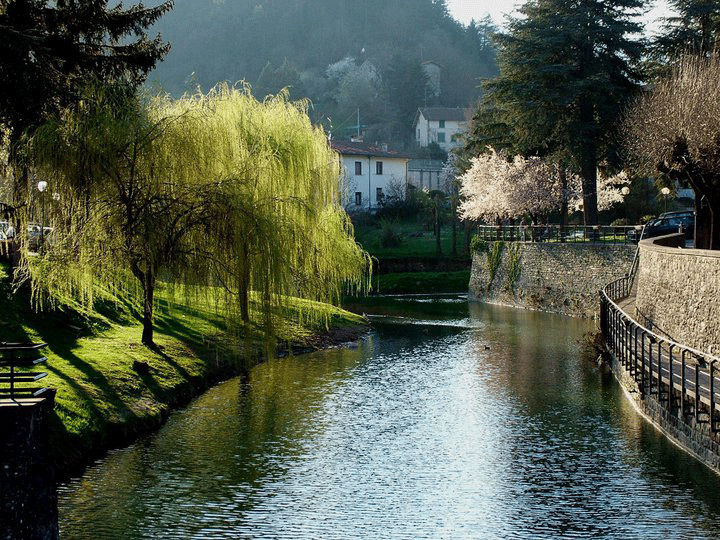 Palazzuolo sul Senio |
 Palazzuolo sul Senio |
 Marradi |
 Sagra delle castagne, Marradi |
 Marradi |
 The chestnuts of Marradi |
 Animosi Theatre, Marradi |
 Steam train, Marradi |
 Acquacheta |
 Acquacheta |
 Acquacheta |
 Casentino Forests Park |
 Casentino Forests Park |
 Casentino Forests Park |
 Premilcuore |
 San Godenzo |
 San Godenzo |
In the heart of Dante's lands, we discover culture, tradition and nature. All the riches passed down over the centuries that take us back to Dante's travels. Dante, that "fugitive Ghibelline", bitterly leaves Florence, but this forced parting will take him outside the "municipium" to discover a vast land, and learn its complexity and potential. The landscapes, rivers, mountains, languages and traditions of these lands will inspire suggestions, theories, knowledge and poetry in Dante.
Let's not miss out on this small trip to discover towns and landscapes fixed in time, places rich with stories to tell--always with Dante's words as company.
Contact our expert:
Itinerary
Duration: two nights, three days.
Way of transport: by car
Itinerary: Marradi, Palazzuolo sul Senio, Acquacheta, Premilcuore, Casentino Forests Park, San Godenzo.
DAY 1 – MARRADI, PALAZZUOLO SUL SENIO
We'll reach Marradi by car. This is a small town in the province of Florence where Romagna dialect is spoken. It overlooks the Lamone river. It's the native town of Dino Campana, who wrote the “Orphic Songs” (must-see: his Native Home):
”Io vidi dalle solitudini mistiche staccarsi una tortora e volare distesa verso le valli immensamente aperte.”
Every fall, Marradi holds the "Chestnut Festival", an old event that takes place over four consecutive weekends, an absolute must.
Must-sees: the Badia del Borgo, or the San Lorenzo Archpriest Church, rebuilt in 1785 in neoclassical style, the Town Hall and the beautiful Animosi Theatre.
We'll then head over to Palazzuolo sul Senio, 11 km away, crossing enchanting beech woods.. Once there, we'll visit the Archaeological Museum of Upper Mugello with findings and events of the upper valleys of the Lamone, Senio and Santerno rivers. Must-see: the Susisana Abbey, 4 km away, an ancient monastery where Moghinardo Pagani was buried, described by Dante as a Ghibelline of uncertain faith (Inferno, Canto XXVII).
We'll head back to Marradi for the night.
DAY 2 – ACQUACHETA, PREMILCUORE AND THE CASENTINO FORESTS PARK
We'll drive over to San Benedetto in Alpe (20 km), where we'll visit the Abbey of the same name that dates back to the 13th century. After that, we'll take a path that in 90 minutes of easy walking will take us to the spectacular beauty of the Acquacheta Falls, also mentioned by Dante.
In the afternoon, we'll head over to Premilcuore, a town that was a fief of the Guidi counts. This small medieval town is dominated by the remains of the ancient Rocca, or Fortress. We recommend a visit to the watermills, which are still active and belong to the millers Mengozzi and Biondi. Because of its beauty and natural setting, Premilcuore boasts of the "Orange Flag", a symbol of tourism and environmental quality. From Premilcuore, we'll head into the Casentino Forests Park, along a thick network of paths that you can travel on foot or on horseback.
DAY 3 – SAN GODENZO
The following day, we recommend a visit to San Godenzo, (25 km from Premilcuore, 40 km from Firenze), and its beautiful Abbey built in 1028, at the behest of the Bishop of Fiesole, Jacopo the Bavarian.
On the 8th of June 1302, the Abbey held a meeting that became famous and is still remembered in the history of Italian Literature: the meeting between the exiled Florence Ghibellines and the White Guelphs, including Dante Alighieri. The objective was to find an agreement with the Ubaldini so they could come back to Florence, which at the time was ruled by the Black Guelphs. The deliberations were unsuccessful: shortly afterwards, there was a bitter clash between White and Black Guelphs with the defeat of the former, while Dante reached the decision to break away from his Florentine friends ("compagnia malvagia e scempia") and "di far parte per se stesso" (as he recalls in his Divine Comedy).
This Abbey is one of the most important examples of Romanesque architecture in Tuscany. The exterior features a clear stone façade with a preceding stairway. The interior is vast and solemn: three naves with square pillars and a raised presbytery, with three apses.


